Two AI models, one gorilla boss
We gave a game character to one AI model to animate, and gave a second model the only job that matters in animation: looking at it and saying what is wrong. The character got better than either model managed alone.
- Question
- Can a model art-direct?
- Method
- Execute, review, rebuild, re-check
- Scope
- 17 animation clips
- Result
- Four measurable gains
A character assembled from parts cannot move like a body.
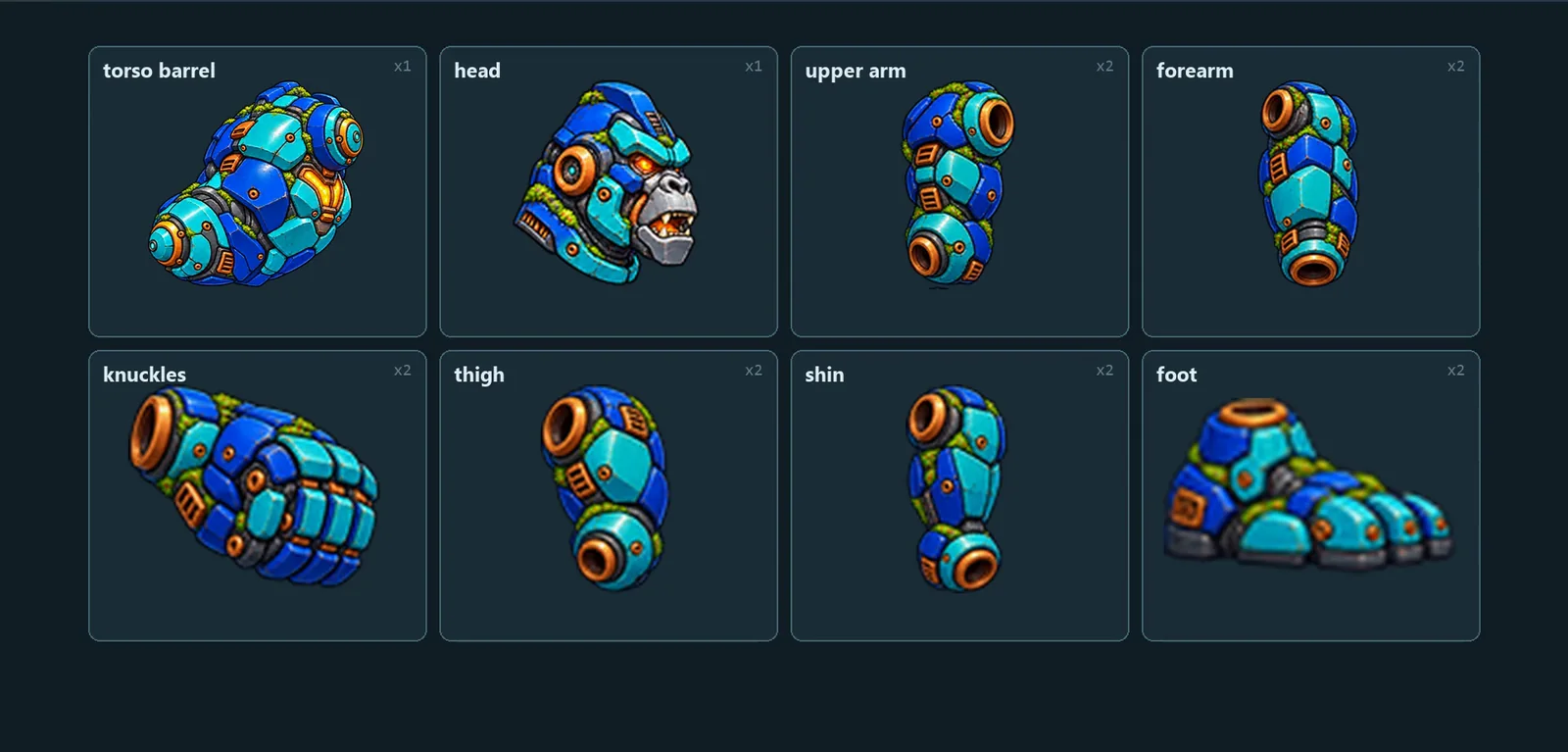
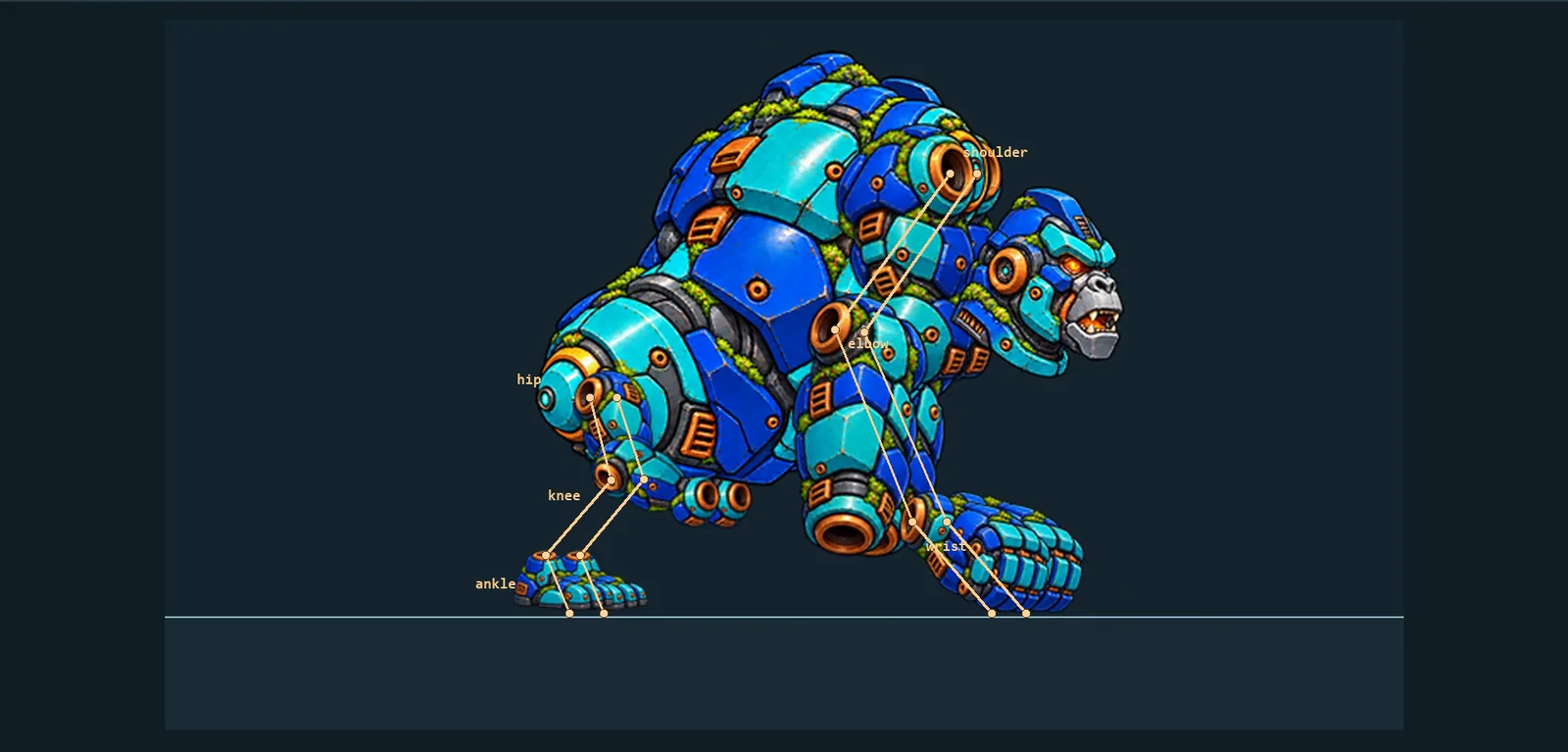
This boss is not a 3D model. He is painted in pieces — a torso, a head, an upper and lower limb, and a knuckle or foot — then assembled at runtime. Each limb is two rigid bones solved onto a target point. Nothing bends inside a piece, so the artwork has to cover every joint, and the solver has no idea what the character is doing.
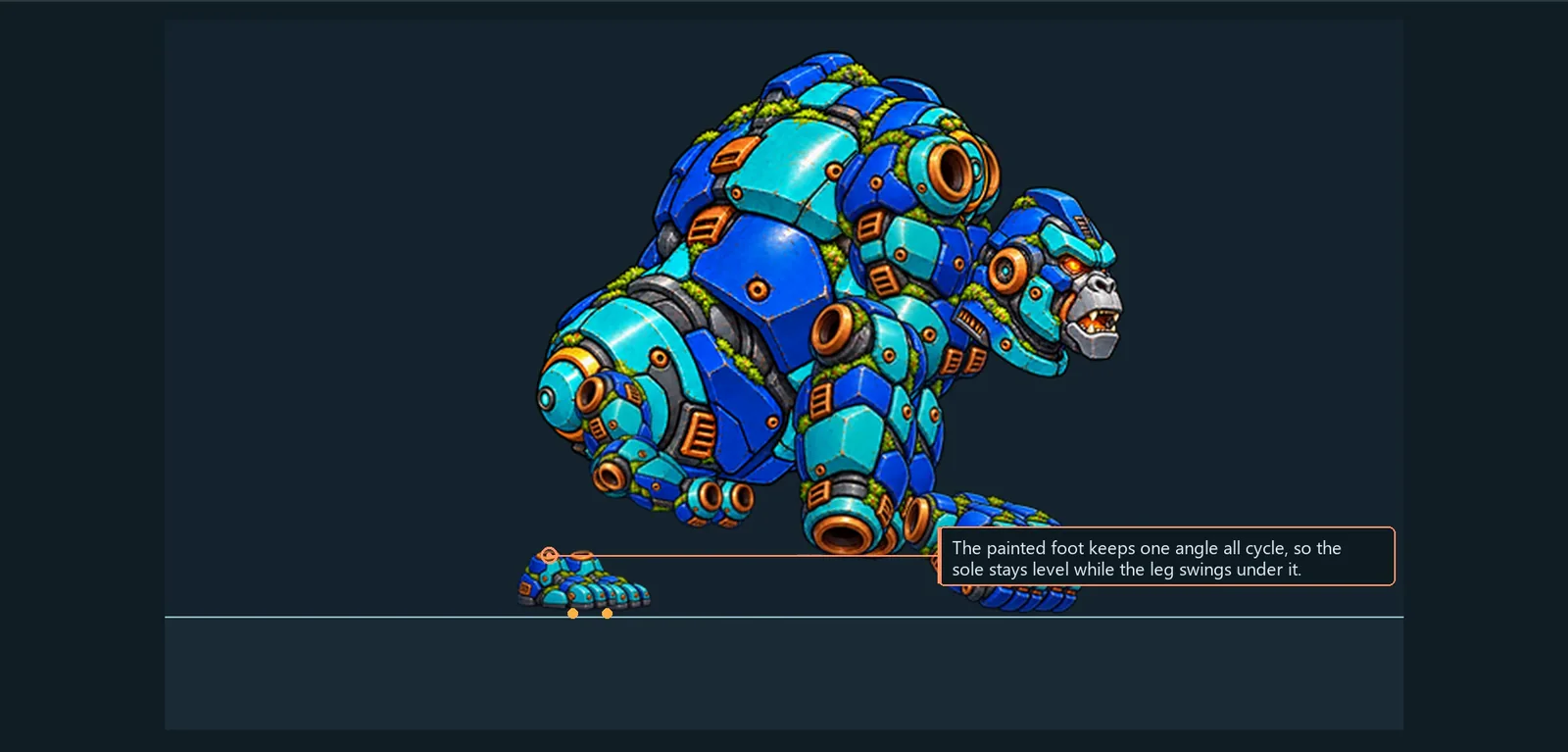
The result reads as mechanical. Feet stay flat while the leg swings under them. At full stretch the solver runs out of reach and the painted joints open up. The torso, the head and the limbs all move on separate clocks. Every one of those problems is obvious in motion and nearly invisible in code.
Put a second model in the loop
One model is a poor judge of its own output. It knows what it intended, so it reads the frames it meant to make. The fix is not a bigger model — it is a second one with nothing invested in the first answer.
- executor
Render the real thing
The build model poses the rig, bakes the drawings and exports the actual frames. No description of the animation — the frames themselves.
- reviewer
Critique the frames
A second model — a different family, no stake in the code — is shown the frames and asked to diagnose what reads wrong, pose by pose.
- executor
Rebuild to the notes
The build model implements the parts of the critique that survive a check against the pixels and the joint landmarks.
- reviewer
Look again
The revised frames go back for a second opinion. Repeat until the reviewer stops finding things and a human signs off.
Nobody checks their own homework.The executor renders and rebuilds; the reviewer only looks. Neither can do the other’s job, which is exactly why the loop works.
Four differences you can measure
Critiques are easy to generate and hard to trust. Every change here was measured on the finished frames rather than accepted from the review, so each line is a number we can re-derive.
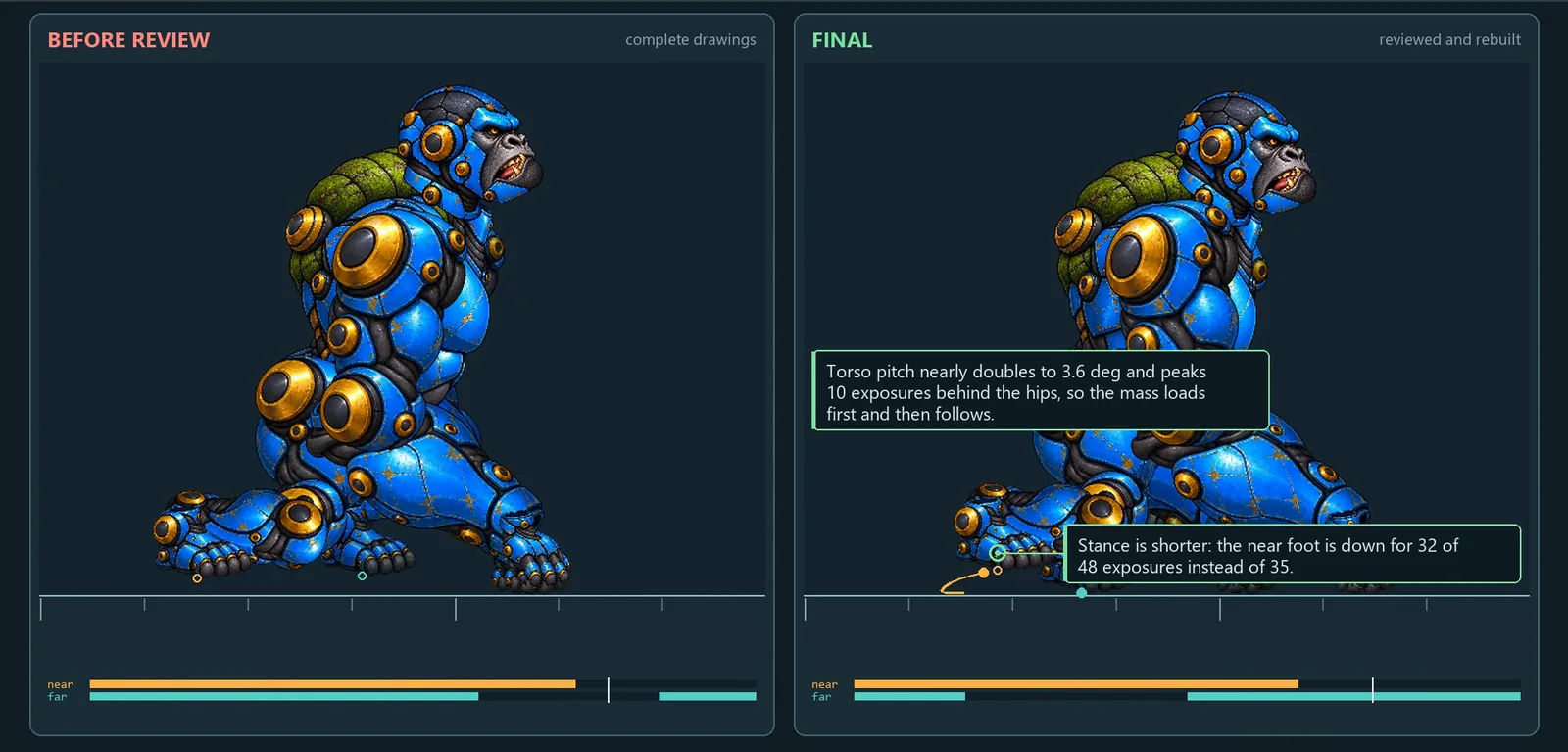
- 35 → 32
Stance length
The walk stopped sharing the floor between both feet and moved to a sequential support order.
- 2.0° → 3.6°
Torso pitch
The mass now loads behind the hips and follows, instead of arriving with them.
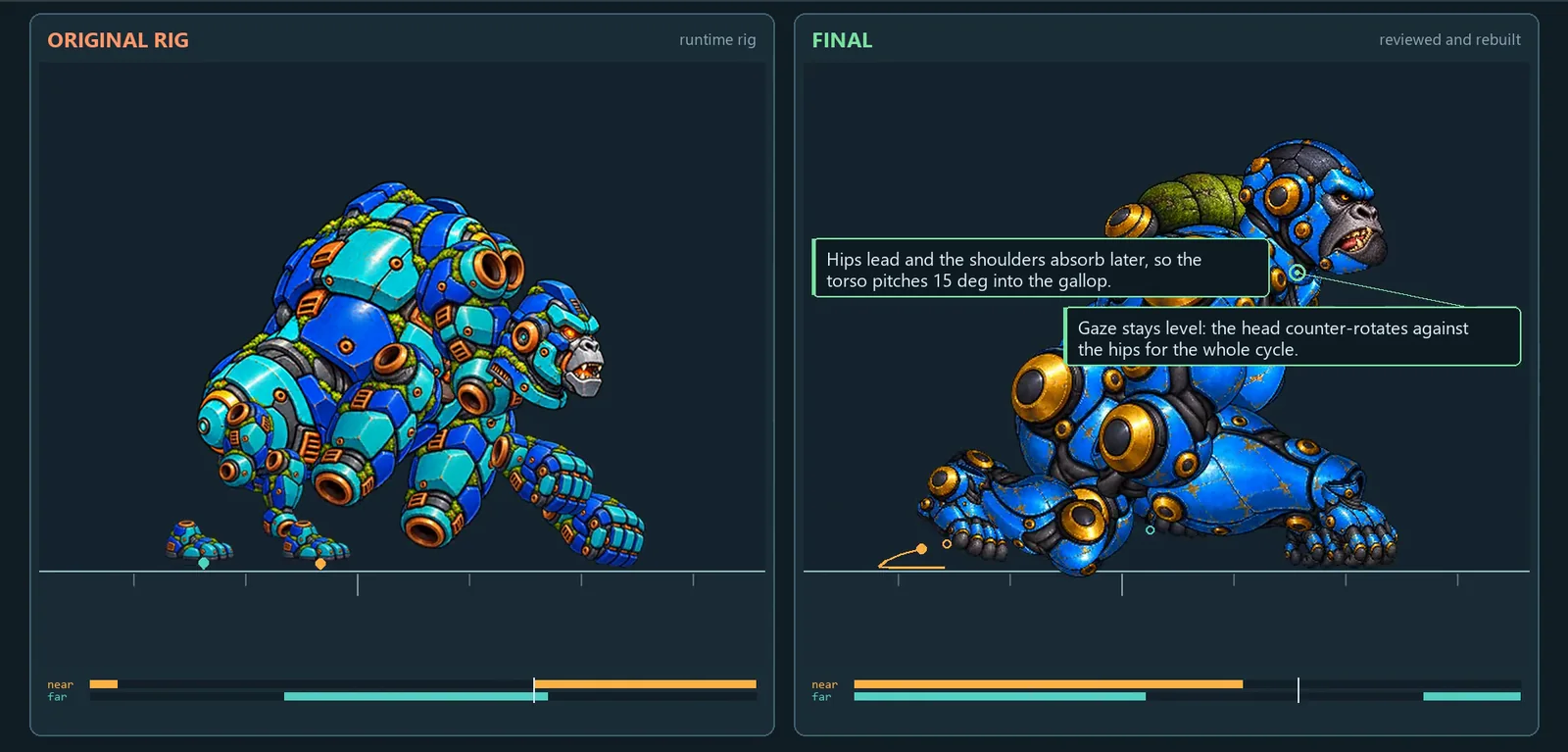
- 60 → 36 px
Hind-foot lift
The gallop's recovery tucks under the body instead of flaring out behind it.
- held level
Gaze
The head counter-rotates against the hips so the boss keeps his eyes on the cat.
What the reviewer was good at — and where it failed
Genuinely useful
- Naming spatial problems in a still: a limb that reads backwards, a silhouette that clutters, a pose that looks defensive instead of aggressive.
- Holding a consistent art direction across seventeen clips, without drifting toward whatever was easy to draw.
- Producing a specific, arguable plan for the next pose — which is what a real animator gives you.
- Catching the same defect on the second pass, when it knew what it had asked for.
Where it needed checking
- It invented precise numbers — degrees, pixel offsets — that were never in the images, and stated them as measurements.
- It claimed to verify pixels from sparse stills, which no stills can support.
- Some advice, followed literally, broke anatomy or broke the continuity between two clips.
- It praised frames that still had real defects. Praise is not a pass.
Treat the reviewer as an art director with strong opinions and no measuring tools. Believe the diagnosis, verify the numbers.
The loop is the product, not the model
The gains came from the shape of the process, not from a particular vendor. A model that produces work needs a separate model that inspects the artefact — the actual frames, the actual deliverable — against a standard it did not set.
That is the pattern we now look for in every engagement: make the output inspectable, put a different model on the inspection, and keep a human as the final judge. It applies to animations, to generated documents, and to anything else where the person who made it cannot see what is wrong with it.
It also sets the honest limit. The reviewer improves taste and consistency. It does not replace the person who decides what the character should feel like — and it should never be the one to sign off.
What have you been imagining?
If you want to test where a review loop would help your own deliverables, we can run the experiment with you.
Back to the Lab